
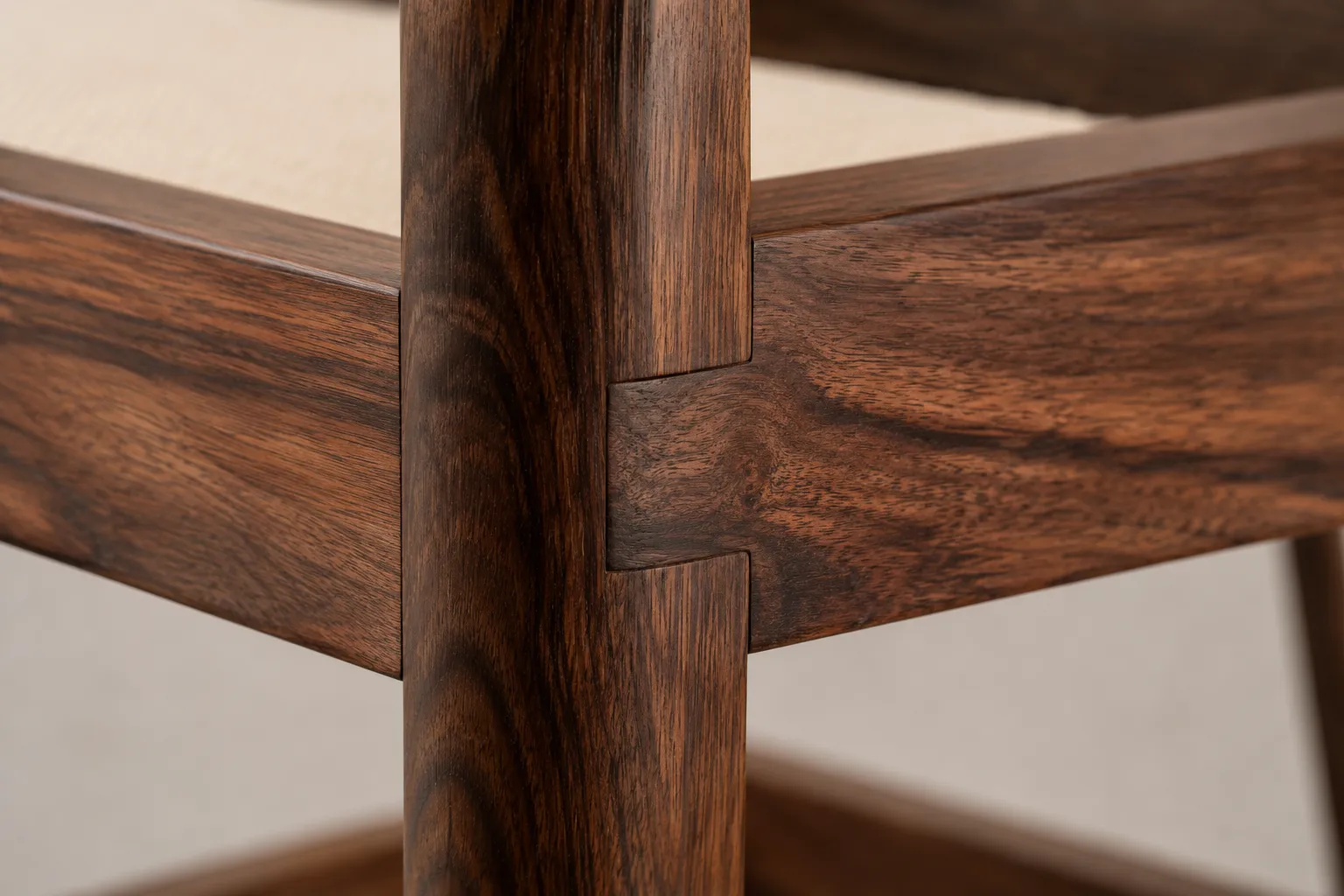
When you look at a premium piece of minimalist furniture, what you don't see is just as important as what you do see. You don't see metal screws, plastic corner brackets, or messy glue lines. Instead, you see clean, uninterrupted lines of wood transitioning smoothly from one plane to another. This is the art of clean joinery.
Joinery is the system used to connect pieces of wood together. In mass-produced furniture, fast joints like metal dowels or pocket screws are used because they are cheap and fast. However, these joints wear out as the wood naturally expands and contracts with the seasons.
We utilize traditional joinery methods—such as mortise-and-tenon and lap joints—modernized through precision machine cutting. By carving interlocking wooden tabs and slots that fit together with absolute friction-fit accuracy, we create a bond that is stronger than the wood itself. Because the joint is made entirely of wood, the connection moves in harmony with the rest of the piece, preventing splitting or wobbling. It is structural integrity made invisible.